First War
A Boy and His DogFirst War is the foundational catastrophe behind the novel’s postwar landscape and social order. It is not presented as a single scene but as a remembered historical rupture whose consequences remain visible in radiation, scarcity, altered bodies, gender imbalance, and the opposed ways survivors inhabit the surface and the downunders.
Historical Rupture and Survival
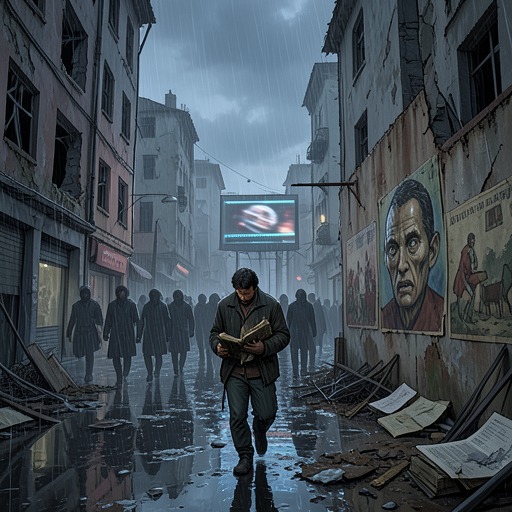
First War has left the surface marked by bluish-green radiation that still flickers from the hills, while craters and dangerous creatures make ordinary travel across the wasteland hazardous. When Vic and Blood move toward the edge of the city, the landscape offers little besides Burnpit-screamers and the access shaft leading to a downunder. The war is therefore not merely a past political event: its material aftermath determines where people can travel, what they can eat, and which forms of life remain possible.
The war also explains the severe shortage of women among the surviving solos and members of roverpaks. Vic understands that most girls were killed, a pattern Blood attributes to the recurrent structure of wars. The demographic damage is compounded by biological damage: many births produce beings that are neither recognizably male nor female and are destroyed immediately after delivery. The result is a population whose sexual and reproductive life has been shaped by mass death, mutation, and coercive scarcity rather than by social stability.
The Prewar Ideal and the Downunders
The communities built below ground are historically defined by their relation to First War. There are only a couple of hundred downunders across what remains of the United States and Canada, sunk at wells, mines, deep holes, or natural cave formations. Their founders selected extreme depth and enclosure as protection from the ruined surface, then used the last scientists to develop the technical means of constructing and maintaining these settlements before expelling them.
The people who established the downunders are described as rigid middle-class groups, including Southern Baptists, Fundamentalists, and law-and-order reactionaries. They reject progress, dissent, and anything that might disturb their chosen social order. Their ideal is the period immediately before First War, which they treat as the best possible time and attempt to preserve as a permanent way of life. In this sense, the downunders are not simply shelters from wartime destruction; they are ideological museums built around a selective memory of the past.
A Manufactured World Below
Vic’s first view of the Topeka downunder makes the historical project physically legible. The settlement is an immense metal tube, twenty miles across, with a ceiling an eighth of a mile overhead and a curved wall enclosing the horizon. At its bottom lies an orderly imitation of an old American town: small houses, curved streets, trimmed lawns, a business district, and the familiar civic arrangement associated with Topeka.
Yet the reconstruction is defined by its absences. It has no sun, birds, clouds, rain, snow, cold, wind, ants, dirt, mountains, oceans, grain fields, stars, moon, forests, or wild animals. The repetition of these missing elements turns the downunder’s apparent safety into a catalogue of deprivation. The settlement has preserved the image of a town while eliminating the natural world and the freedom that once made life outside its walls possible. Its inhabitants are therefore described as being canned in their refuge, like dead fish.
Psychological and Social Consequences
The war’s legacy is experienced as a conflict between protection and imprisonment. Vic initially enters the downunder as an outsider, but the artificial town quickly becomes intolerable. Its residents repeat polite routines, maintain lawns, operate gas stations, read on benches, attend communal activities, and reproduce the gestures of an earlier civic life. Their food is equally synthetic: artificial peas, fake meat, make-believe chicken, ersatz corn, and bogus bread taste to Vic like chalk and dust.
Within a week he feels the metal enclosure closing around him and senses the weight of the earth overhead. The downunder’s cleanliness, order, and civility become forms of pressure rather than comfort. The settlement’s attempt to escape the consequences of First War thus produces another kind of damage: a closed society that suppresses dissent, natural experience, and personal freedom. Vic’s reaction shows that survival underground has preserved bodies and routines at the cost of psychological openness.
Continuing Legacy on the Surface
The surface society that emerges after First War is equally shaped by the catastrophe, but it responds through mobility, predation, and improvisation rather than enclosure. Roverpaks form from foraging solos, and the scarcity of women makes sexual relationships objects of pursuit, capture, and violence. Vic’s encounters and expectations are inseparable from the demographic destruction attributed to the war, while Blood’s role as tracker and companion helps them navigate a landscape where radiation, craters, and dangerous creatures are ordinary conditions.
The war also sharpens the novel’s contrast between two failed attempts to manage catastrophe. The downunders deny change by reconstructing a sealed prewar past; the surface survivors accept instability but reproduce exploitation and brutality. First War is the historical source of both conditions. Its most lasting significance lies in showing that catastrophe does not end when the weapons stop: it persists in bodies, ecosystems, institutions, food, sexuality, memory, and the struggle between enclosure and freedom.